
Click here to catch up with Part 1 of this series.
Over the past couple of weeks I’ve been spending more time with Anna Butterfield and Steve Dimmick’s extraordinary collection of art and design magazines from the 1920s – 1950s.
As I read, a picture is emerging of the person who bought (and saved) these magazines. In some issues, there are tantalising glimpses of their original owner. Tucked into the December 1951 issue of The Artist I came across a clipping from the Daily Telegraph showing Princess Elizabeth and the Duke of Edinburgh at a cocktail party.
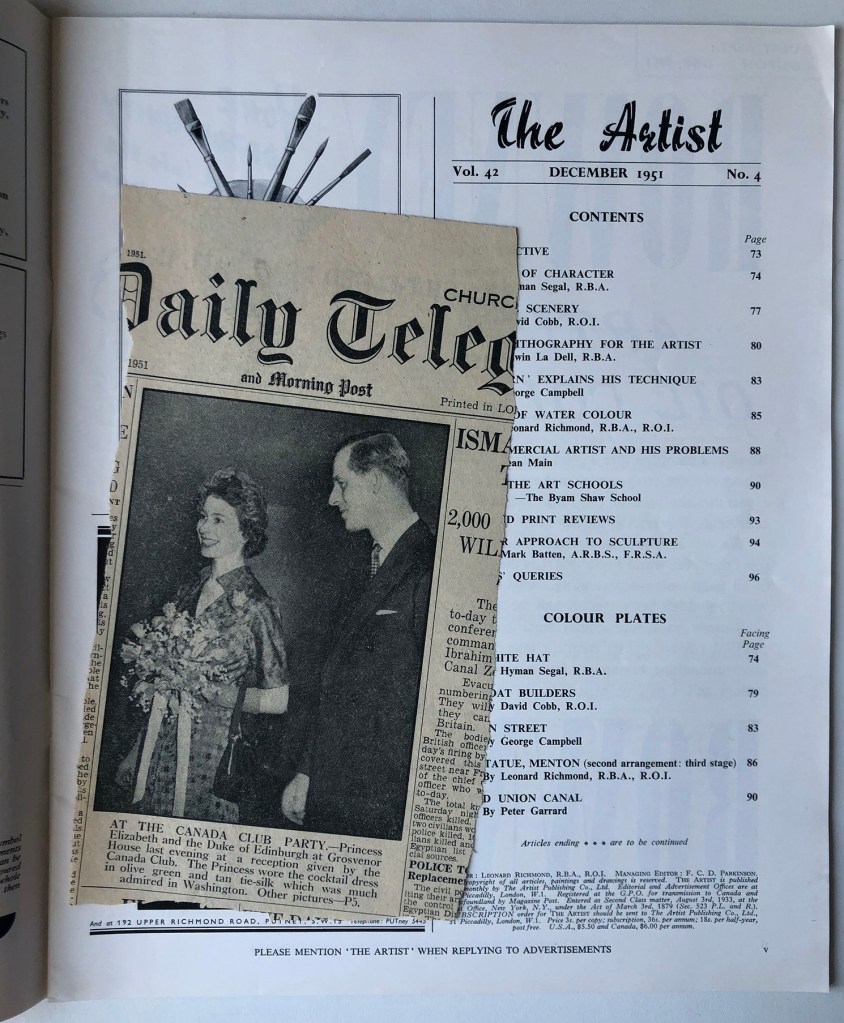
I wonder what made the owner save this particular photograph. Was it the inspiration for their own creative practice? In earlier issues of The Artist, columnists such as the poster artist Horace Taylor advised readers to save photographs from magazines and newspapers as references for their own work.
Elsewhere, missing pages or cut out adverts offer further hints about the owner’s interests. Here an advert has been cut from the January 1929 issue of The Studio.
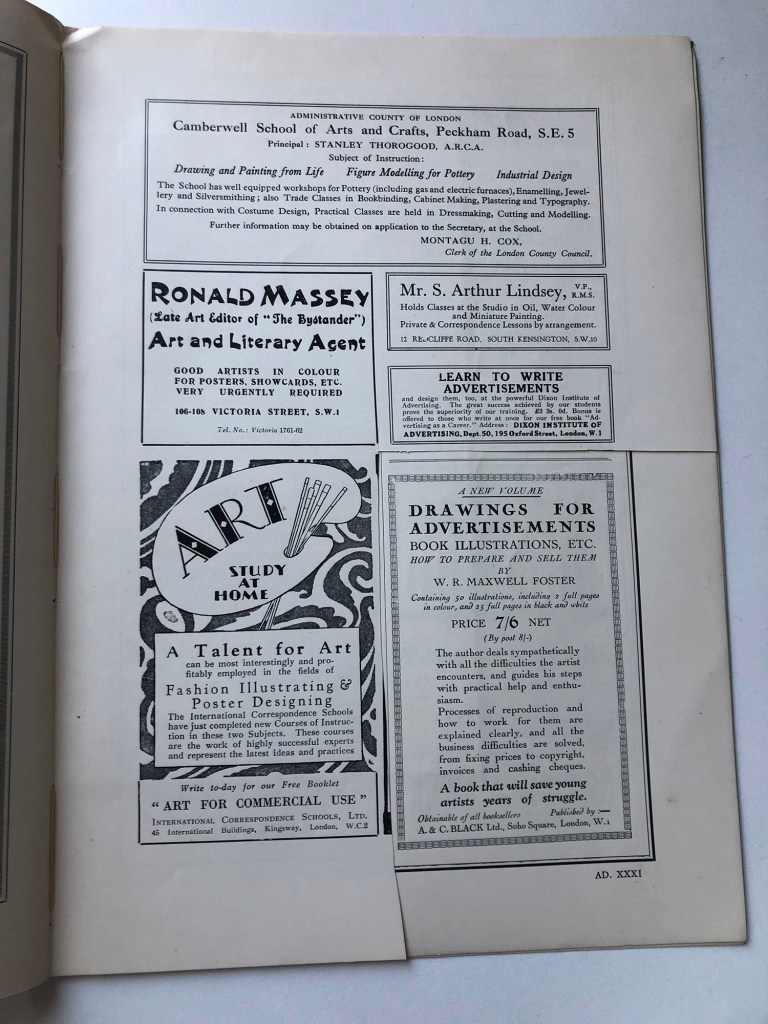
Without cross-referencing an intact copy of the magazine, I can’t tell what the advert was for (do get in touch if you have a copy and can let me know!). If I had to make a guess, though, I imagine that the ad was for an art school, possibly a correspondence one. When I met Anna, she thought that the magazines had belonged to a female relative with an interest in painting, especially watercolour.
This interest in painting is reflected in the selection of magazines that survive. Many of them placed an explicit emphasis on practical advice and instruction, such as The Artist, whose tagline was ‘A Magazine Giving Instruction in All Branches of Art’. The Artist clearly meant a lot to Anna’s relative. There are more issues of this magazine than the other titles put together. Looking inside, it’s not hard to see the attraction.
Each magazine consisted of a series of introductory guides by famous artists on their chosen medium. Issues in the first two volumes opened with an article by the painter Dorothea Sharp on Oil Painting, which guided readers through a particular aspect of painting in oils.
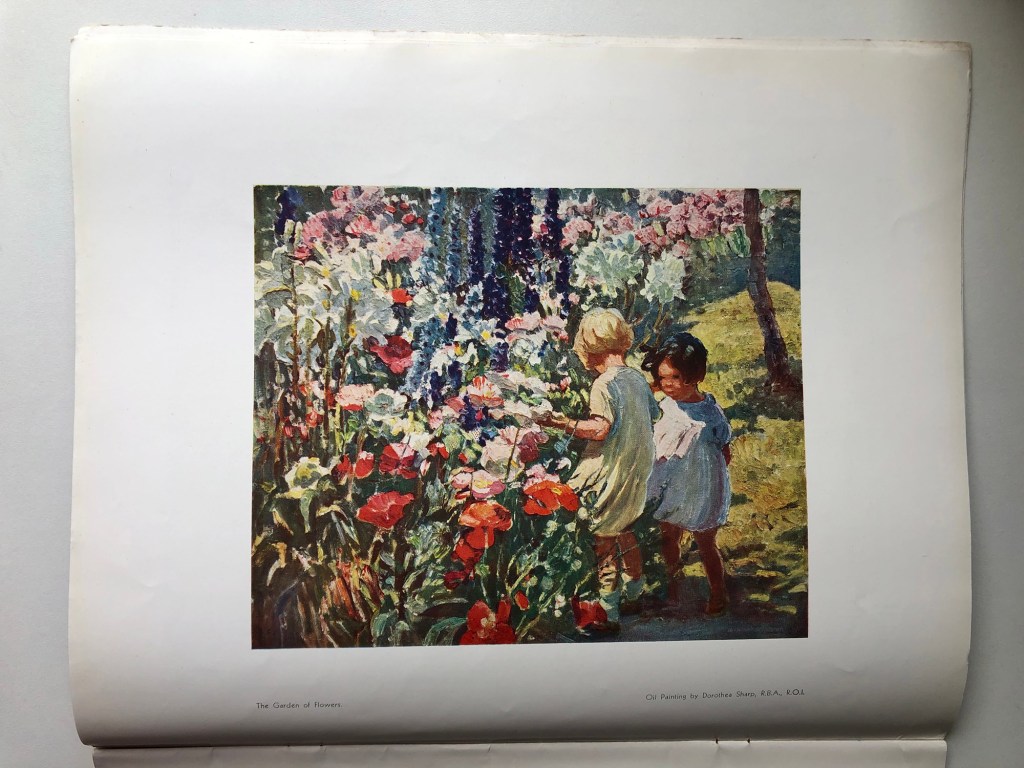

I love Sharp’s illustration of a palette, which helped beginners choose and organise their paints.
Alongside oil painting, there were pieces on poster designing, wood engraving, lino-cutting, watercolours, pen and ink, pastels, and pencil drawing. As an amateur watercolourist myself, I was immediately drawn to Leonard Richmond’s careful and supportive lessons on watercolour landscapes.
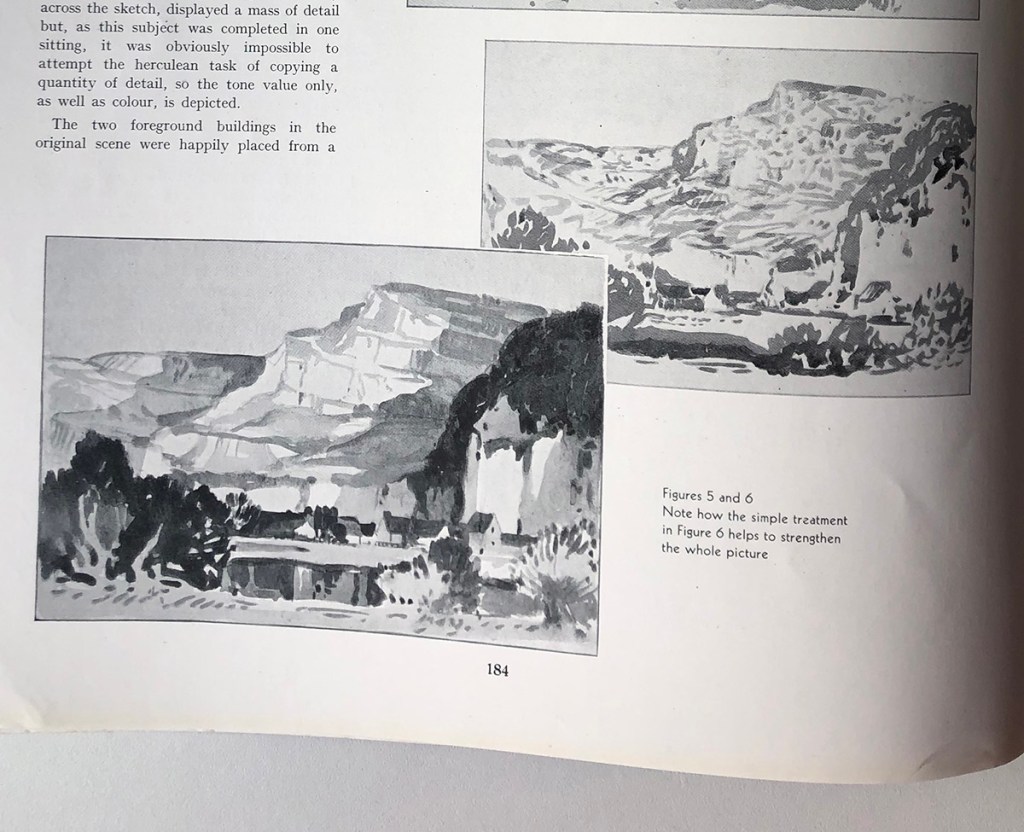
I can definitely see myself following his above advice about simplification. I tend to avoid landscapes because I find them too hard, but maybe I’d have more confidence if I followed a few of his lessons!
The Artist is full of stunning visuals. Iain Macnab’s articles on wood engraving are particularly beautiful.
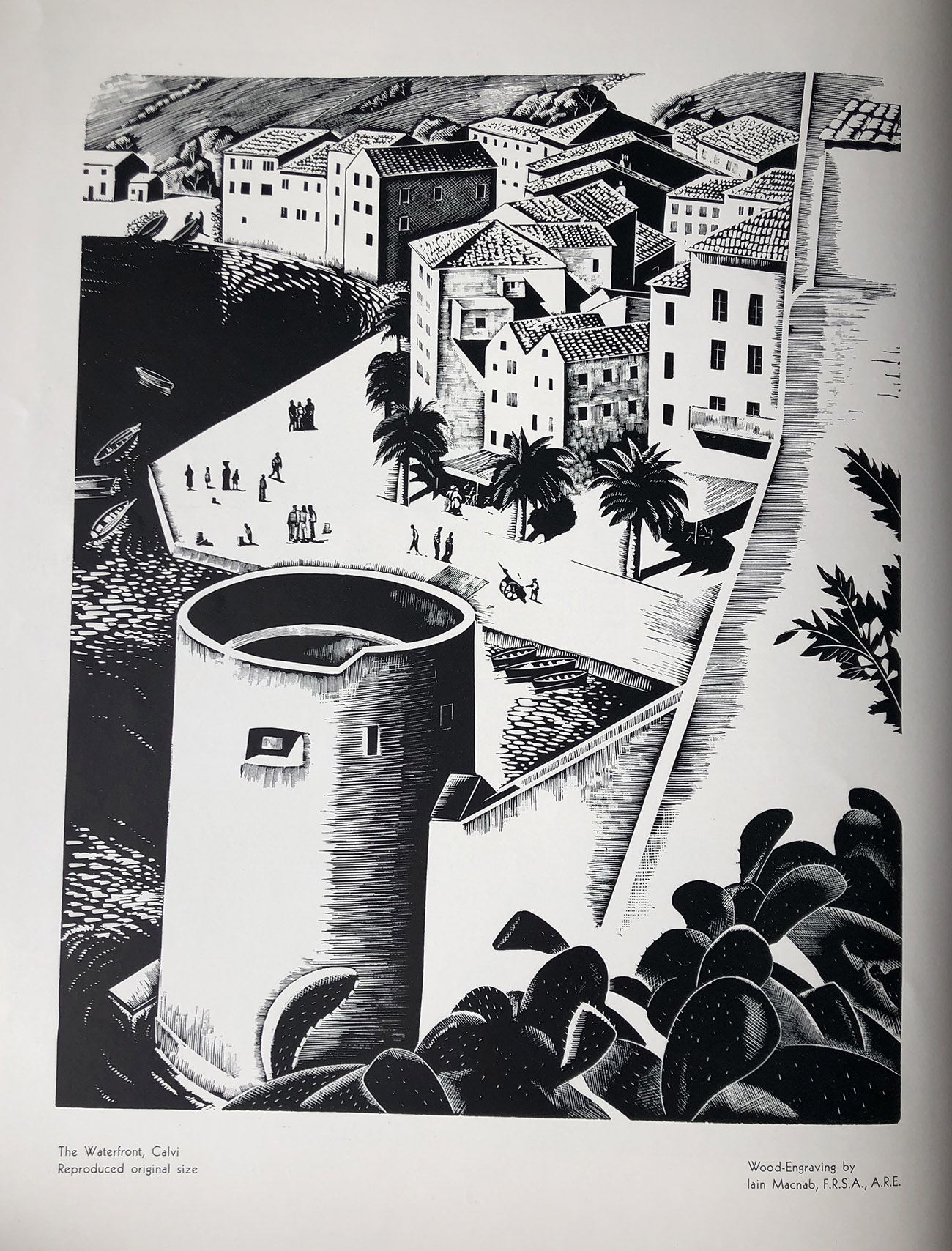

Aside from instructional articles, the magazine encouraged members of the public to write in with questions or to seek advice. Some of the questions received were very specific. One reader in Aberdeen wrote to ask ‘What colours should I use for Ash and Birch trees in the middle distance, and what colours for shadows of trees in the foreground?’ The answer: work it out for yourself. But others received more constructive replies. L. P. W. from Blackpool was having trouble with the quality of their line:
Q: In drawing with the pen, how is it that my lines are ‘wobbly’ rather than straight, and how can I draw lines like Mr. Ferrier does?
A: It is all a matter of practice. You obviously draw your lines slowly, and without confidence—whereas Mr. Ferrier slashes them in with speed and vigour, knowing what he wants and how to do it—and then getting on with it. If you practice drawing lines of varying thicknesses quickly, you will gain confidence—then your quality of line will improve.[1]
This seems like very sound advice.

My interest in these magazines, apart from being beautiful objects, is how they made enjoying and producing art and design accessible for ordinary people. Those unable to do an art degree could learn at home. Others could pursue a hobby without engaging a tutor. The Artist clearly hit a chord: we learn in the third issue that the publishers vastly underestimated the public interest in the magazine, and that the first issue sold out within a week. This might explain why the first issue is missing from this collection. Getting hold of a back copy was so tricky that the editors printed a plea from New York Public Library, asking any reader with a spare copy of No. 1 to send it to them. It looks as if their plea went unanswered as the NYPL still doesn’t have a copy of the first issue in their collection.
After an initial flurry, copies of The Artist in Anna and Steve’s collection become more sporadic. The cover price of 2 shillings was expensive: a subscription in 1931 would have cost £27 a year. The National Archives’ useful currency converter tells us that’s £1,236.21 in today’s money (as of 2017). That equated to 81 days’ wages for a skilled tradesman. I imagine that only quite wealthy, middle-class readers would have had the money to buy The Artist on a regular basis.
In 1935, 1936 and 1937, the only surviving issue is for the month of May. I wonder whether May was a special month. Could the issues have been bought as a birthday treat or in anticipation of a summer holiday?
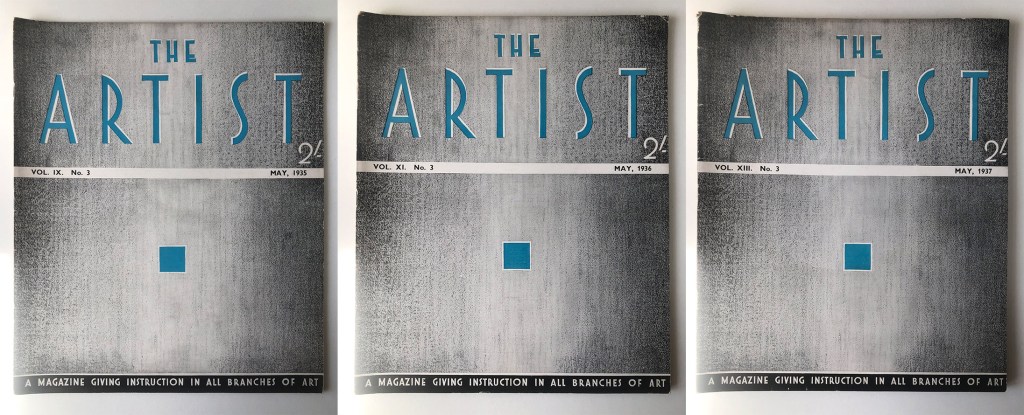
We’ll never know the answers to some of these questions, but one thing’s for sure: spending time with an individual collection makes for a very different reading experience than working with magazines in most archives or libraries. I rarely get the opportunity to sit down and peruse a set of periodicals that belonged to just one person. Doing so gives a sense of character that’s often lost when individual collections are subsumed into larger ones. It’s an important reminder that magazines have life histories: they bear the traces of human hands. With every annotation, dog-eared page or missing advert, we get an insight into what these periodicals meant for their previous owners. I’m proud to be part of their ongoing story.
I’ll continue to share pictures and stories from this collection over the coming weeks. If you’d like to receive updates by email, sign up to the blog using the links on the right (on desktop) or below (on mobile). With thanks, once again, to Anna Butterfield and Steve Dimmick for their generous loan and permission to share photographs online.
[1] ‘Readers Queries Answered’, The Artist, 1.4 (June 1931), 137.
 Revolutionary Red Tape
A very interesting overview of a fascinating collection.
LikeLike