
I’m looking forward to speaking at my first in-person academic conference since early 2019 in late June. Along with Kristin Bluemel, Luke Seaber and Michael McCluskey, I’ll be speaking at the British Association for Modernist Studies (BAMS) conference ‘Hopeful Modernisms’ in a panel on ‘Rural Britain and Everyday Modernism’.
My paper, ‘The Arts as/and Community Healing in Postwar Britain’, will explore the Arts League of Service and the broader drive to democratise and decentralise the arts in the years immediately following the First World War. The talk is based on the ‘Village Halls’ chapter from my in-progress book, Art for the People: Everyday Encounters with the Arts in Modern Britain. I’m excited to share it with fellow modernist enthusiasts, and to start conversations which can continue over lunch/drinks/dinner. Virtual and hybrid conferences have been fantastic, but I’ve missed the little chats over coffee cups you get at in-person events.
Here’s the draft description of our panel:
In the aftermath of global catastrophe of World War I, could the arts help remake the world? The four papers collected in this panel demonstrate that the answer among British writers, artists, publishers, community groups and arts organisations was emphatically ‘Yes.’ It seemed that there was no problem that wider access to literature, books, and the arts could not fix. Focusing on rural Britain as a particularly rich area generating hopeful, democratic forms of everyday modernism, the panellists’ subjects range from aviation literature to ‘Art for the People’ exhibitions, from General Post Office films on the connected village, to the radically democratic illustrative forms of 1930s countryside books.
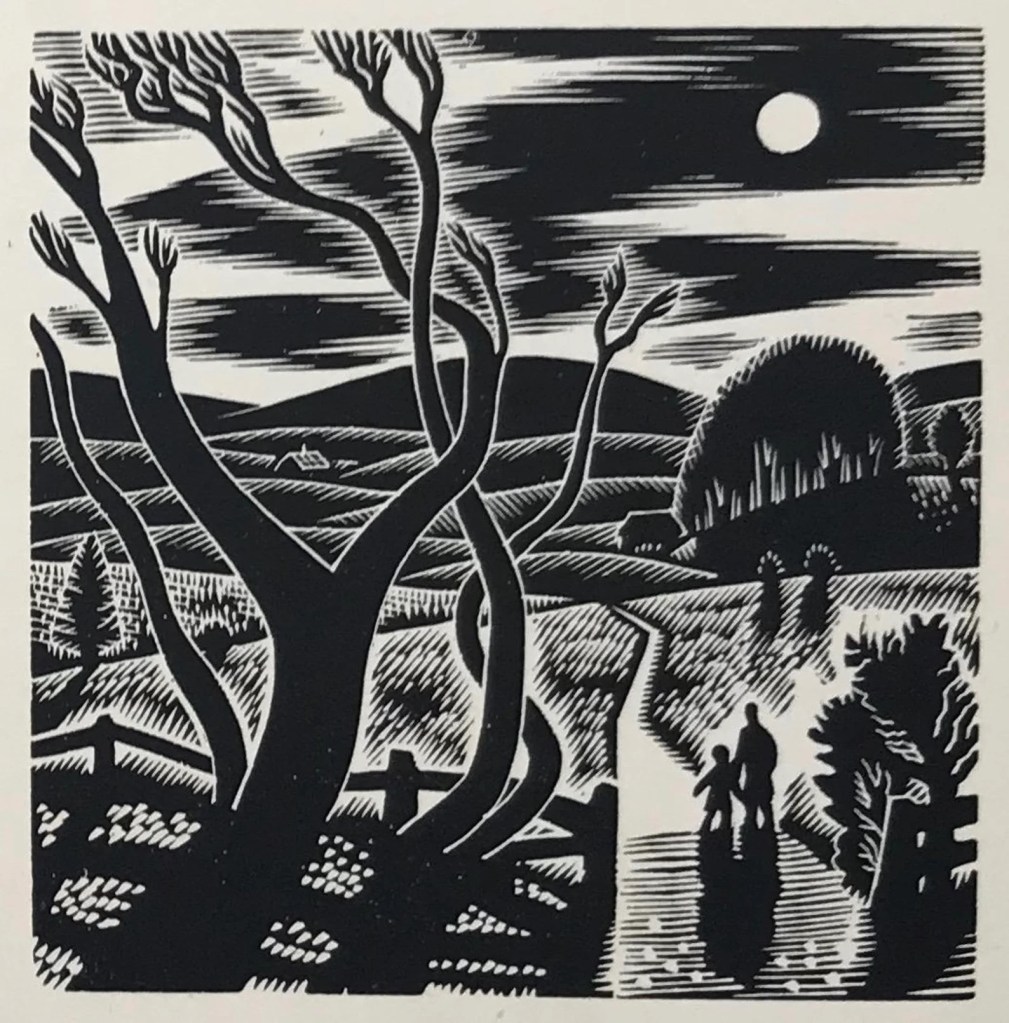
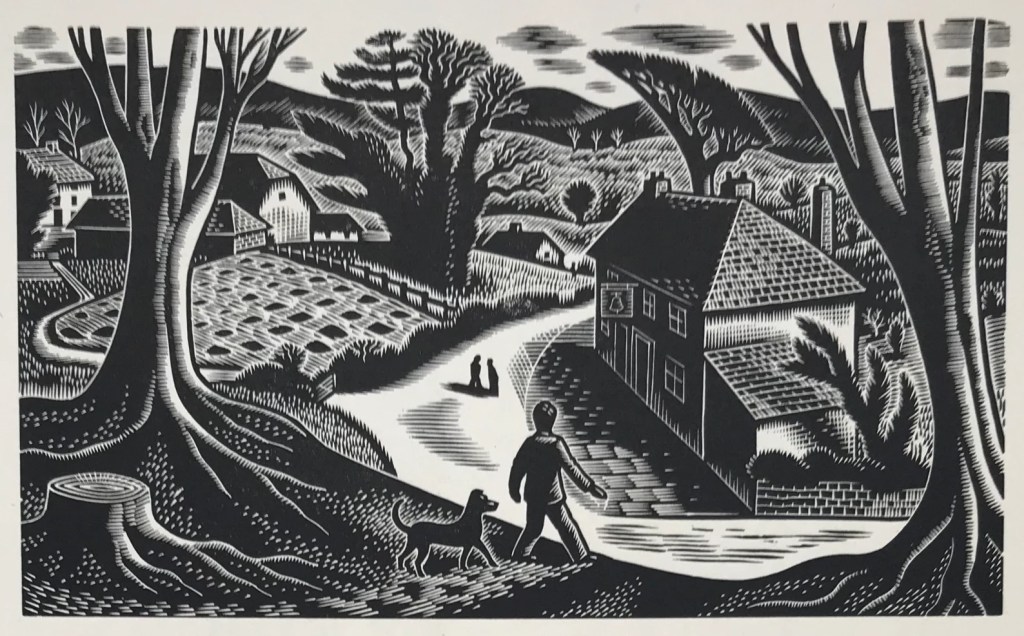
I’m particularly looking forward to hearing Kristin Bluemel on 1930s countryside books. When I think about rural Britain and everyday modernism my mind goes to the beautiful wood engravings of rural life produced during the first half of the twentieth century, by Gwenda Morgan, Clare Leighton and Agnes Miller Parker, to name but a few. I’ve included some of Morgan’s beautiful wood engravings on this page: I particularly love this image, in which a man and his dog stride down a woodland path to get to The Bell Inn. To view more of her work, visit the Kevis House Gallery.
Here’s the abstract for my paper:
This paper explores how two nationwide movements – the drive to decentralise and democratise the arts – facilitated everyday encounters with modern art, design and performance in rural communities across Britain. From the Arts League of Service travelling theatre to the British Institute of Adult Education’s peripatetic ‘Art for the People’ exhibitions, communities could engage with modern art without leaving their villages or market towns. In this paper, West introduces some of the schemes which aimed to bring the arts from cities and into the country, exploring the complex cultural politics at stake. Although these schemes were well intentioned, they often veered into cultural paternalism, predicated as they were on the assumption that the taste and behaviours of those living in rural areas needed to be ‘improved’.
For more information about ‘Hopeful Modernisms’, or to register, visit the BAMS website.
 Revolutionary Red Tape